Modern vehicle platforms are adding more wireless functions to support positioning, telematics, safety communication and passenger services. As GNSS, cellular, V2X, Wi-Fi, Bluetooth, UWB and AM/FM are added, the antenna system must fit more RF functions into limited vehicle space.
Using a separate antenna for every function can increase the number of mounting points, cables, connectors and integration tasks. An automotive combination antenna addresses this packaging challenge by placing multiple independently designed antenna elements in one housing.
The goal is not simply to use fewer antennas. A practical combination antenna must also maintain frequency coverage, RF isolation, reliable signal quality and compatibility with the vehicle platform.
Why These Wireless Links Are Difficult to Combine
The main challenge is that each wireless system has different RF requirements. GNSS is a sensitive receive-only system that depends on stable phase-center behavior and right-hand circular polarization. Cellular systems require wideband coverage and may use several MIMO branches. V2X requires consistent communication around the vehicle, while Wi-Fi, UWB and AM/FM introduce additional frequency and interference considerations.
For automated driving applications, these requirements become even more important. The National Highway Traffic Safety Administration defines Level 4 automation as a system that can perform the driving task within a limited operating area without requiring a takeover-ready human driver. An antenna does not make a vehicle autonomous, but reliable positioning and communication are essential subsystems within the vehicle’s operating design domain. NHTSA Automated Vehicle Safety
V2X is also moving toward wider transportation deployment in the United States. In 2024, the U.S. Department of Transportation announced a national V2X deployment plan and nearly $60 million in related grants. This makes V2X antenna compatibility a practical design consideration for new connected vehicle platforms. USDOT V2X Deployment Plan
What Does a Combination Antenna Integrate?
A combination antenna, also called a combo antenna, combines two or more antenna elements or wireless functions inside one enclosure. Common configurations include:
- GNSS and cellular
- GNSS and 4G/5G
- 5G MIMO and Wi-Fi
- GNSS, 5G and V2X
- Cellular, Wi-Fi, Bluetooth and AM/FM
A GPS integrated antenna may use one element for satellite positioning and another for cellular communication. A more advanced automotive antenna may include several 5G branches for MIMO, separate V2X elements and optional short-range communication functions.
One common misunderstanding is that one housing means one cable. In practice, each internal antenna element usually has its own RF port and cable so it can connect to the correct modem or receiver. The benefit comes from shared mechanical packaging and simpler installation, not from eliminating every RF connection.
How Automotive Combo Antennas Simplify Vehicle Integration
| Integration factor | Separate antennas | Combination antenna |
|---|---|---|
| Roof or mounting space | Requires several locations | Consolidates functions in one housing |
| Cable routing | Multiple independent paths | More centralized cable routing |
| Vehicle assembly | More mounting and sealing steps | Fewer mechanical installation steps |
| Platform adaptation | New antenna layout may be needed | Functions and ports can be configured |
| RF design risk | Easier to isolate physically | Requires careful internal isolation |
For fleet vehicles, passenger vehicles and autonomous shuttles, fewer housings can reduce visual clutter and simplify mechanical design. A centralized antenna assembly can also make it easier to adapt one platform for different markets or communication requirements.
However, a combo antenna is not automatically the best choice for every vehicle. If a platform only needs GNSS and one cellular link, a simpler antenna may provide better cost control. A combination antenna becomes more valuable when the vehicle uses several radios, has limited roof space or must support multiple platform variants.
How to Choose an Automotive Combination Antenna
1. Start with the complete radio list
List every current and planned function before choosing the antenna:
- GNSS constellations and bands
- 4G LTE and 5G bands
- Number of 5G MIMO branches
- DSRC or C-V2X requirements
- Wi-Fi, UWB, Bluetooth and AM/FM options
For the U.S. market, V2X requirements should be checked against the vehicle module and spectrum design. FCC rules address C-V2X operation in the 5.9 GHz ITS band, including technical limits for on-board and roadside units. FCC C-V2X Rules
2. Check RF performance, not only frequency coverage
Important specifications include gain, efficiency, VSWR, impedance, isolation, radiation pattern and polarization. For high-precision GNSS, also request phase-center variation, LNA gain and noise figure.
A frequency list alone does not show whether all systems can operate reliably at the same time. Inter-element and inter-system isolation are especially important when high-power cellular transmission is installed close to a sensitive GNSS receiver.
3. Match the antenna to the vehicle structure
Confirm the required connector, cable length, cable exit direction and mounting method. FAKRA connectors are commonly used in automotive applications, while SMA may be suitable for some development platforms and industrial systems.
Also consider roof curvature, ground-plane size, overhead clearance, wind resistance, vibration, moisture and temperature. The best automotive antenna is the one that fits both the RF design and the physical vehicle environment.
4. Validate the complete system
Testing should include more than an antenna chamber measurement. The final vehicle system should be checked for:
- Cable loss and connector compatibility
- GNSS C/N0 and positioning stability
- Cellular throughput and MIMO balance
- V2X coverage and communication reliability
- EMC and interference performance
- Operation during vibration, temperature and weather exposure
Example Solutions: HX-AUST002 and HX-AULT002
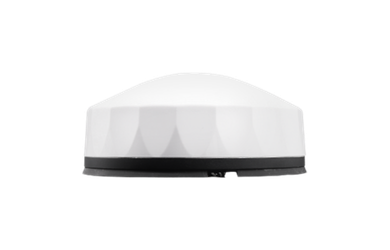
Harxon’s HX-AUST002 and HX-AULT002 show how an automotive combination antenna can be configured for connected vehicle platforms.
The HX-AUST002 uses a shark-fin housing and integrates one GNSS antenna, four 5G antenna branches and two V2X antenna branches. Its listed dimensions are 160 × 80 × 68 mm, with customizable FAKRA connections and screw mounting.
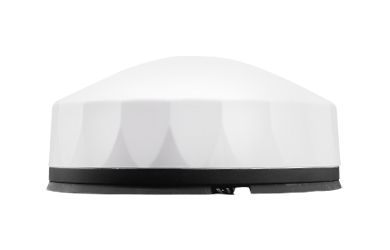
HX-AULT002 low-profile automotive combination antenna
The HX-AULT002 uses a compact low-profile housing and provides the same core configuration of one GNSS, four 5G and two V2X antenna elements. Its listed dimensions are 135 mm in diameter and 57 mm in height, with a FAKRA-Z female connector and screw-fixed installation.
Both models support GNSS L1/L2/L5 and additional multi-constellation bands, 5G ranges from 824–960 MHz, 1710–2690 MHz, 3.3–3.6 GHz and 4.8–5.0 GHz, plus V2X coverage from 5.85–5.925 GHz. Their published specifications include 50-ohm impedance, GNSS phase-center variation of no more than 2.5 mm and inter-system isolation of no more than -15 dB.
Wi-Fi, UWB and AM/FM functions can also be considered when the vehicle platform requires additional connectivity.
Expert Tips and Common Mistakes
- Start with the system function list instead of selecting by appearance.
- Check frequency bands, RF ports, isolation and connectors together.
- Validate the antenna, cables and vehicle modules as one RF system.
- Ask for test conditions instead of relying only on peak specifications.
- Do not assume that one housing means one cable.
- Do not select an antenna based only on frequency coverage.
- Do not use a standard 5G or Wi-Fi antenna as a direct replacement for V2X without validation.
- Do not claim that an antenna alone enables Level 4 automated driving.
Conclusion
The best combination antenna is not necessarily the one with the largest number of functions. It is the configuration that matches a vehicle’s required bands, ports, isolation, mounting and environmental conditions while leaving room for future upgrades.
By combining GNSS, cellular and V2X functions in one engineered housing, automotive combo antennas can reduce mechanical complexity and simplify modern vehicle connectivity. If you are planning a connected vehicle or autonomous driving antenna system, share your vehicle type, frequency bands, RF port requirements, connector preference, mounting method and operating environment with Harxon. Our engineering team can help evaluate the right combination antenna configuration and develop a solution for your platform.
FAQs
Is a combination antenna the same as a single antenna?
No. It is usually one housing containing multiple independently designed antenna elements, often with separate RF ports.
Can a combo antenna support GNSS, 4G/5G and V2X together?
Yes, if the antenna is designed for the required bands, port configuration and isolation performance.
Does a combination antenna reduce the number of cables?
It may simplify cable routing, but each internal antenna element commonly requires its own RF connection.
Should every connected vehicle use a combination antenna?
Not necessarily. It is most useful when a vehicle needs several wireless functions, has limited installation space or requires a flexible multi-platform design.