
In an increasingly connected world, Global Navigation Satellite System (GNSS) antennas have become indispensable in applications ranging from UAVs and robotics to marine navigation and autonomous vehicles. But not all GNSS antennas are created equal. Two major categories stand out: standard GNSS antennas and anti‑jamming GNSS antennas. Understanding the difference—and when to choose which—is critical to ensuring robust, accurate, and reliable positioning. Here, I walk you through what each type offers, the trade‑offs, and ultimately how to decide which one you need. And yes, at Harxon, we've spent years perfecting both.
A standard GNSS antenna is the baseline workhorse in satellite-based navigation. These antennas are designed to receive signals from GPS, GLONASS, Galileo, BeiDou, and more, across one or multiple frequency bands. Their typical characteristics include:
Broad constellation and frequency support
Low-noise amplifiers (LNAs) to boost weak satellite signals
Compact, low-power design for general-purpose use
For example, Harxon's HX-CVX606A ruggedized GNSS antenna supports multiple constellations (GPS, GLONASS, Galileo, BeiDou, QZSS, IRNSS, SBAS) and delivers stable performance even in high shock and vibration conditions.
Standard GNSS antennas are ideal when you primarily need reliable positioning in ''clean'' environments—where electromagnetic interference is minimal or manageable. Applications such as basic surveying, standard UAV operation, or general mapping often fall into this category.
Yet, the real world isn't always so forgiving. In many cases, GNSS signals face two significant challenges:
Electromagnetic Interference (EMI): This includes unintentional noise from other RF sources, such as communication radios, broadcasting stations, or even nearby electronics.
Jamming or Spoofing: Intentional interference—whether malicious or accidental—that disrupts GNSS reception.
When these threats arise, standard GNSS antennas can struggle. They may saturate, lose lock, or degrade in accuracy due to multipath effects, out-of-band noise, or even signal spoofing.
That is where anti-jamming GNSS antennas come into play. Unlike their standard counterparts, these antennas are engineered to actively mitigate interference, ensuring the GNSS receiver continues to function even in hostile RF environments.
Some of the strategies used by anti-jamming antennas include:
Antenna arrays: Multiple elements that can form spatial nulls to reject interference from particular directions.
Beamforming: Adjusting the phase and amplitude of different antenna elements to steer reception and suppress unwanted signals.
Pre-filtering / multi-stage filtering: Filtering out out-of-band noise before signals reach the LNA.
Polarization suppression: Limiting reception of undesired polarized signals (e.g., suppressing signals from certain directions or polarization types).
Mode switching: The ability to switch between anti-jamming and normal reception modes, depending on conditions.
These features are particularly useful in environments with complex electromagnetic interference, intentional jamming, or strong multipath.
At Harxon, we recognized early on that standard GNSS antennas were not enough for every scenario. That's why we invested in developing a dedicated line of anti-jamming GNSS antennas, tailored for high-demand applications.
Key Products
JM004: This model integrates a 6-element B1L1E1 anti-jamming antenna array around a full-band GNSS element. Its beamforming array can suppress multipath and interference by controlling beam direction, while multi-stage pre-filters reject out-of-band noise. The unit supports GPS, BeiDou, Galileo, GLONASS, and more. Built in a rugged, IP67-rated marine enclosure, it's designed for demanding conditions: shock, vibration, lightning protection, and even overvoltage resilience.

JH001 / JH002 / JH003: These are helix-style or OEM GNSS antennas with enhanced anti-interference performance. For instance, the JH003 uses beamforming and pre-multiple filtering to suppress out-of-band noise and multipath. The JH002, on the other hand, is a dual-frequency OEM GNSS antenna with bottom-mounted suppressors and filtering to mitigate interference.
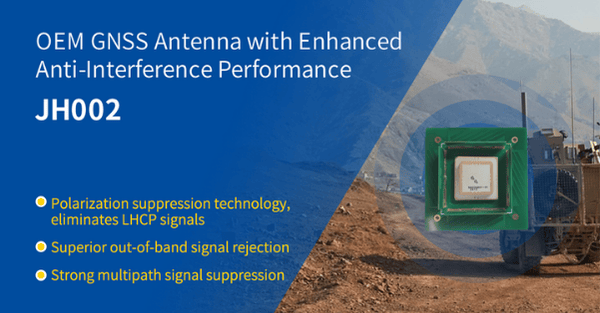
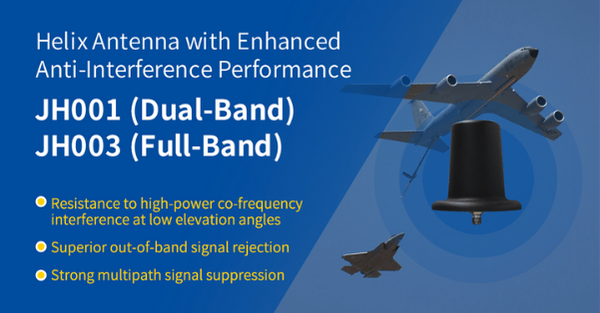
These products illustrate how Harxon blends advanced beamforming, array design, and multi-stage filtering to deliver truly resilient GNSS performance.
Choosing between standard and anti-jamming GNSS antennas isn't just a technical decision—it's about risk, environment, and mission-critical reliability. Here are some scenarios where anti-jamming becomes indispensable:
High-Interference Zones: Industrial sites, military facilities, or urban areas with dense RF traffic.
Marine and Maritime: Ships or offshore platforms exposed to radar, communication systems, and other transmitters. Harxon's JM004 is built precisely for these environments.
UAVs and Drones in Critical Missions: When drones operate near strong RF sources (e.g., radio towers) or in sensitive operations, maintaining GNSS lock is vital. The JH-series helix antennas from Harxon are well-suited here.
Autonomous Vehicles / Robotics: Self-driving or autonomous systems often rely on consistent and accurate GNSS positioning even when near communication infrastructure.
Security and Defense Applications: Jamming is a real threat in defense contexts; anti-jamming antennas offer a layer of resilience.
If your application runs in relatively clean RF environments, standard GNSS antennas may suffice. But if you cannot tolerate signal degradation—or if loss of positioning could lead to mission failure—then anti-jamming solutions are worth the investment.
That said, going anti-jamming isn't without its trade‑offs:
Power Consumption: Anti‑jamming antennas often need more power, especially when beamforming and array processing are active.
Size & Weight: More elements and more complex housings may mean a bigger, heavier antenna.
Cost: Naturally, the advanced hardware and signal processing increase cost over a basic GNSS patch or helix antenna.
Complexity: Deployment might require more careful mounting, orientation, and power management, especially for array antennas.
Therefore, when recommending or selecting a GNSS antenna, I always weigh the application risk profile against these trade‑offs.
What makes Harxon stand out is our holistic approach. We don't just offer anti-jamming antennas; we continue to deliver standard GNSS antennas with high precision, robustness, and integration flexibility.
Our survey-grade antennas give you calibrated, multi-constellation performance for geodetic or high-precision mapping.
Our helix antennas, such as the HX-CHX600A with patented D‑QHA technology, deliver stable phase center and low-elevation tracking.
Meanwhile, our smart antennas integrate RTK modules, combining precision positioning with a compact design.
At Harxon, we don't force you into one path. We help you choose the right antenna based on your risk profile, environment, and application, and we back that with integration support and customization options.
Here is a simplified decision framework I use when consulting clients or planning a project:
Low-risk (clean RF): standard GNSS antenna likely suffices
Moderate/high risk: consider anti‑jamming
If losing GNSS lock is a ''nice to avoid'' → standard
If losing GNSS lock is a ''cannot afford it'' → anti‑jamming
Power, weight, size
Mounting options and shock/vibration requirements
Compare upfront cost, integration cost, and risk mitigation value
At Harxon, we guide you through trade‑offs. We can even tune or customize antennas to your specific needs.
In summary, standard GNSS antennas remain a reliable and cost‑effective choice for many applications. But in environments where interference, jamming, or multipath pose serious risks, anti‑jamming GNSS antennas provide the resilience and integrity you need.
At Harxon, we recognize the full spectrum of GNSS requirements. Our portfolio—from rugged helix antennas to advanced multi-element anti-jamming series—is designed to give you both performance and peace of mind. When choosing your antenna, consider your operational environment, risk tolerance, and platform constraints. If you're operating in interference-prone zones or on mission-critical tasks, I strongly recommend exploring our anti-jamming offerings.


