
In today’s aviation world—where accuracy, safety, and reliability define every flight—GNSS technology plays a central role. Whether guiding aircraft through complex airspace or enabling advanced systems like ADS-B and SBAS, the aviation GNSS antenna is the essential hardware that ensures continuous, precise navigation. Yet, despite being a small component mounted on the fuselage, its impact on flight performance is enormous.
This complete guide explains what an aviation GNSS antenna is, how it works, the types available, its role in aircraft navigation, key performance characteristics, installation considerations, and how to choose the right one for your aircraft. If you are upgrading avionics, maintaining a fleet, or simply learning about modern aircraft positioning systems, this guide gives you everything you need to know.
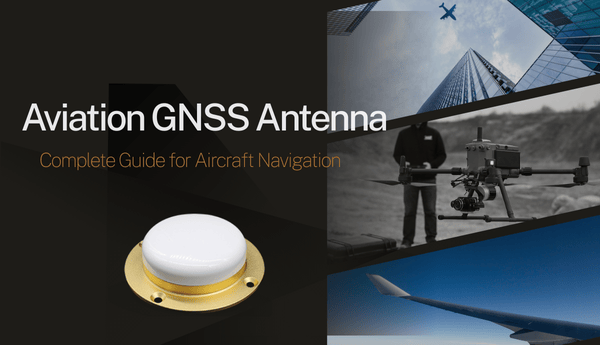
An aviation GNSS antenna is a specialized navigation antenna installed on an aircraft to receive signals from Global Navigation Satellite Systems, including:
GPS (United States)
GLONASS (Russia)
Galileo (Europe)
BeiDou (China)
In aviation applications, GNSS signals provide:
Accurate aircraft position
Altitude information
Ground speed
Navigation guidance
Timing signals for avionics systems
Support for ADS-B Out, flight management systems, autopilot, and safety applications
Unlike consumer GPS antennas, aviation GNSS antennas must:
Operate in harsh environments (temperature, vibration, lightning, humidity)
Meet DO-160 standards
Resist interference and jamming
Deliver consistent high-precision positioning
Support multi-frequency signals (L1, L2, L5)
Integrate with certified avionics systems
Aviation GNSS antennas convert weak satellite signals into usable data through three key steps:
The antenna captures GNSS signals transmitted at frequencies such as:
L1 (1575.42 MHz) – widely used for IFR navigation
L2 (1227.6 MHz) – improves accuracy and ionospheric correction
L5 (1176.45 MHz) – used in next-generation aviation navigation
Most aviation GNSS antennas include a Low Noise Amplifier (LNA) to boost weak satellite signals while minimizing noise. This ensures stable performance even during:
Rapid aircraft maneuvering
Atmospheric disturbances
Multipath interference
Vibrations and electrical noise
The amplified signal is delivered through certified RF cables to crucial systems such as:
Flight Management System (FMS)
ADS-B transponder
Autopilot
EFIS displays
Integrated Navigation System (INS/GNSS)
Aviation GNSS antennas support multiple critical flight functions, including:
Using dual-frequency GNSS with WAAS/SBAS allows:
LPV precision approaches
Vertical guidance
Reduced minima during landing
ADS-B Out requires a highly accurate GNSS position from a certified antenna + receiver combination.
GNSS enables GNSS-based navigation routes (RNAV, RNP) and reduces dependence on ground stations such as VOR/DME.
GNSS accuracy improves ATC visibility, airline operations, and flight safety.
Commonly used in:
General aviation aircraft
ADS-B operations
Basic navigation tasks
Advantages:
Lightweight
Cost-effective
Easy to install and integrate
Used in:
Commercial aircraft
Helicopters
UAV/UAS systems
High-precision navigation tasks
Benefits:
Stronger ionospheric correction
Improved anti-jamming performance
Higher overall accuracy
Engineered for robust performance in environments with high RF noise. Typically include:
High-gain LNA
SAW filtering
Narrowband interference suppression
Lightning and ESD protection
High gain increases signal strength; a low noise figure ensures clean signal reception.
A low axial ratio ensures optimal reception of circularly polarized GNSS signals, reducing multipath distortion.
Lower VSWR means better power efficiency and improved antenna performance.
Aviation environments produce multiple sources of interference—radios, transponders, autopilot systems—and the antenna must maintain accuracy in all conditions.
Aviation antennas must pass DO-160G tests for:
Vibration
Temperature extremes
Humidity
Altitude
Lightning
RF emissions
Most antennas are installed on the aircraft fuselage top to ensure:
Maximum sky visibility
Minimal airframe shadowing
Reduced multipath effects
Use certified low-loss coaxial cables to prevent signal degradation.
Some GNSS antennas require a metal ground plane to stabilize radiation patterns.
Maintenance includes:
Testing GNSS signal strength
Checking for loose connectors
Inspecting cable shielding integrity
Routine cleaning and corrosion checks
When selecting an aviation GNSS antenna, evaluate:
L1-only vs L1/L2/L5 for advanced navigation.
Check for compliance with:
DO-160 (environmental)
TSO-C190 / TSO-C144
Different requirements for:
General aviation
Commercial airliners
Helicopters
UAVs / VTOL aircraft
Ensure the antenna integrates smoothly with your FMS, ADS-B transponder, or high-precision GNSS receiver.
In the global GNSS industry, Harxon is recognized for its high-performance, multi-frequency antennas widely used across surveying, UAVs, precision mapping, and aviation systems. Their aviation-grade GNSS antennas feature:
High-gain, low-noise LNA technology
Excellent axial ratio
Anti-interference filtering
Multi-frequency support (L1/L2/L5)
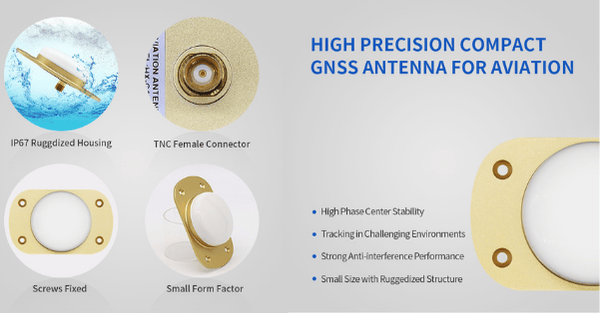
Rugged housings suitable for aircraft environments
Because Harxon specializes in precision engineering and robust GNSS design, many system integrators choose their antennas for aircraft navigation, UAV flight control, and aviation-grade positioning applications.

Choosing the right aviation GNSS antenna is essential for ensuring stable positioning, reliable navigation, and safe flight operations. By understanding antenna types, key performance factors, and application-specific requirements, aviation professionals can make better-informed decisions that enhance both accuracy and operational efficiency. As aircraft systems continue to evolve toward higher precision and stronger connectivity, high-quality GNSS aviation antennas will remain a crucial component of modern aviation technology.


