
Choosing a radio modem is a long-term investment in the reliability of your entire industrial communication system. The right choice ensures consistent performance even in demanding environments.
With a wide range of industrial radio modems available, the key is to know which features actually matter and which don’t.This buying guide is designed to help you evaluate your options, compare solutions, and select the right radio modem for your operational needs.
In industrial wireless communication, a radio modem acts as the bridge between field data and control systems. Whether it’s sensors collecting real-time information or control centers issuing commands, the modem ensures that this exchange happens reliably across distance
An industrial radio modem essentially converts digital data into radio signals for transmission, and then back into usable data at the receiving end. While this function sounds straightforward, the real challenge lies in maintaining performance under varying conditions, such a interference, obstacles, and long-distance transmission.
Unlike consumer-grade devices, industrial radio modems are built to support mission-critical operations. In applications like SCADA or remote monitoring, even minor communication delays or data loss can affect system visibility and decision-making. This is why factors like signal stability, latency, and coverage are far more important than basic connectivity.
In many cases, especially when deploying a long-range radio modem, the modem effectively defines the limits of your entire network, how far it can reach, how stable it remains, and how well it adapts to complex environments.
Understanding this role is essential when evaluating options and selecting the right radio modem for your specific application.
Selecting a radio modem for industrial wireless communication is not simply a matter of comparing specifications. It requires a comprehensive evaluation based on your specific application, operating environment, and communication requirements.
A reliable industrial radio modem should not only meet basic data transmission needs but also maintain stable performance under real-world conditions. To make the right decision, several key factors need to be carefully considered.
For applications such as remote monitoring or distributed systems, communication range is often the priority. A long-range radio modem enables stable data transmission in areas where wired infrastructure is unavailable or impractical. It is also important to consider actual coverage performance in environments with obstacles or complex terrain.
Industrial environments are often subject to electromagnetic interference, equipment noise, and environmental factors. Unstable communication can directly impact system performance. A well-designed radio modem should provide strong resistance to interference to ensure consistent connectivity.
Different applications have different communication requirements. For example, automation systems are more sensitive to latency, while monitoring systems prioritize stability. Choosing the right modem involves balancing data rate and reliability based on your use case.
Industrial sites often involve harsh conditions such as extreme temperatures, dust, and vibration. The durability of the device plays a critical role in long-term system performance. An industrial-grade radio modem should be built to withstand these challenges and reduce maintenance risks.
The radio modem should integrate seamlessly with existing systems such as SCADA, PLCs, or remote monitoring platforms. At the same time, it should support future expansion, allowing your communication network to scale as your operations grow.
Taking these factors into consideration, you can select the best radio modem for your application and ensure reliable, long-term industrial wireless communication.
In industrial wireless communication, there is no one-size-fits-all solution. Instead of simply comparing specifications, the key is to select a solution that aligns with your specific application requirements.
Different use cases, system architectures, and performance expectations determine what kind of industrial radio modem you actually need.
In SCADA systems or system integration projects, communication typically involves continuous data exchange between multiple remote sites and a central control system. In such scenarios, stability and predictable latency are far more important than peak data rates. Any fluctuation in the communication link can affect both data acquisition and control execution.
For these applications, industrial-grade solutions such as HX-DU1018D embedded radio modems are often preferred, as they offer reliable long-term performance and strong compatibility with industrial devices like PLCs and RTUs. For these scenarios, it is recommended to use highly reliable and low-latency radio modems with strong system compatibility.
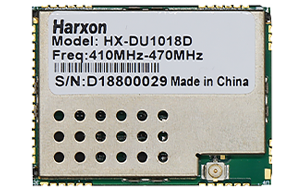
In remote monitoring scenarios such as utilities, water management, agriculture, or oil and gas pipelines, communication environments are often more challenging. Devices are deployed over long distances, often without access to reliable public networks. In these cases, the key requirement is consistent and reliable communication over time. A long-range radio modem, such as HX-DU1012R, is well-suited for such deployments, offering stable performance and low power consumption for unattended operation.
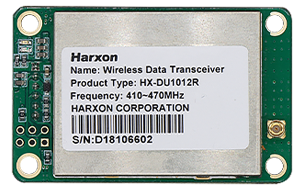
In industrial automation and OEM integration scenarios, communication devices must not only be reliable but also easy to integrate. These applications often require compact size, low power consumption, and flexible configuration. Embedded radio modems like the HX-DU1018D provide a good balance between performance and integration flexibility, making them suitable for a wide range of industrial devices and systems.
In complex environments such as mining sites, factories, or dense urban areas, communication quality is often affected by electromagnetic interference, physical obstructions, and multi-path effects. These challenges typically result in unstable connections rather than complete signal loss.
In such cases, selecting a robust industrial radio modem with strong interference resistance is essential. Harxon’s solutions are designed with optimized modulation and stable communication mechanisms, making them suitable for these demanding environments.
Different industrial scenarios impose different requirements on communication systems. Instead of focusing solely on specifications, it is more effective to choose a solution that performs reliably in specific conditions.
Below is a quick comparison table to help you understand the key differences among Radio Modem, LoRa, and Cellular networks, you can make an informed decision based on your specific application needs.
Feature | Radio Modem | LoRa | Cellular Network |
Latency | Very low (real-time) | High (non-real-time) | Medium with variability |
Network Dependence | Zero dependence (self-built private network) | Lower (requires gateway) | High (requires base station coverage) |
Interference Resistance | Very strong (designed for complex environments) | Average (prone to same-frequency interference) | Average (affected by load/gain) |
Accuracy | Centimeter/millimeter level | Meter/sub-meter level | Sub-meter/centimeter level (dependent on network stability) |
Primary Applications | RTK surveying, drones, and agricultural autonomous driving | Environmental monitoring, meter reading | Vehicle networking, standard handheld location tracking |
Radio Modem is the best option for applications requiring real-time response, high-precision positioning, and strong stability, particularly in harsh environments and self-built private networks.
LoRa and Cellular Networks are more suitable for low-bandwidth applications like remote monitoring and vehicle networking. But their network dependence and vulnerability to interference can compromise performance, especially in high-precision or real-time scenarios.
For projects that demand high reliability, accuracy, and low latency, Radio Modem is undoubtedly the best choice.
Choosing the right radio modem is critical for ensuring stable and reliable industrial wireless communication. With a variety of options available, it’s essential to evaluate the specific requirements of your application, whether it's real-time communication, long-range coverage, or low-latency performance.
Harxon provides reliable and high-performance radio modems designed for challenging industrial environments. Whether you’re working in remote monitoring, SCADA systems, or industrial automation, Harxon delivers the durability and stability needed for mission-critical operations.
To ensure your industrial communication system is optimized for both performance and longevity, contact Harxon today. Let our expert team help you choose the right radio modem for your needs and guide you toward a more reliable and efficient communication solution.


